
In This Article
Let’s be honest: for most of the last century, the ceiling fan had a bit of an image problem in Britain. Too American. Too holiday-villa. Too “why do you need that, it’s only 19°C?” energy. And then came the summer of 2022. Then 2023. Then last year. Suddenly, the idea of a quietly spinning, beautifully designed ceiling fixture started looking rather sensible.

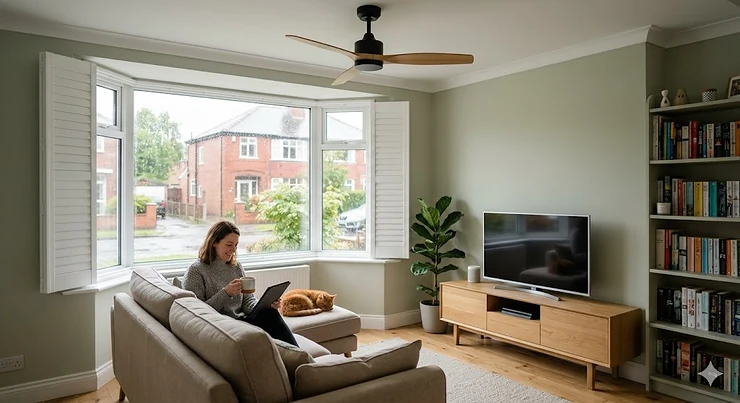
But here’s the thing — the modern designer ceiling fan is not the plastic-bladed, wobbling eyesore of your parents’ Costa del Sol timeshare. Not even close. Today’s designer ceiling fans are genuinely architectural objects: sculptural, whisper-quiet, energy-smart, and increasingly at home above a well-considered British sitting room as they are above a Malibu deck. They’ve earned their place on the ceiling.
So, what exactly are designer ceiling fans? At their core, they’re ceiling-mounted air circulation units that combine a reversible DC motor (typically under 35W) with premium materials — think brushed aluminium, solid walnut, matte black steel, or handblown glass — in designs considered as carefully as any pendant light. The best models double as statement ceiling fans with lights, pulling full illumination duty whilst simultaneously moving air. Many now integrate with Alexa or Google Home. In short: they’ve become proper grown-up design objects.
More practically: a good ceiling fan uses as little as 0.05 kWh per hour — a fraction of what even a modest air conditioning unit consumes. Run it through a warm British evening and you’re looking at pennies, not pounds. In winter, flip the motor to its clockwise setting and it redistributes the warm air that naturally pools near your ceiling, which can cut heating costs by around 10%. Not nothing, particularly when energy bills are what they are.
In this guide, I’ve researched and assessed seven of the best designer ceiling fans currently available on Amazon.co.uk — across budget, mid-range, and premium tiers — with real UK context throughout. Let’s get into it.
Quick Comparison: Designer Ceiling Fans at a Glance
| Product | Diameter | Motor Type | Light Included | Smart Control | Price Range (GBP) | Best For |
|---|---|---|---|---|---|---|
| Hunter Fan Industrie II | 132cm | AC Reversible | No (optional) | Wall control | £150–£220 | Heritage / industrial lofts |
| Hunter Fan Carera | 132cm | AC Reversible | No (optional) | Pull chain | £130–£190 | Classic period rooms |
| Ovlaim 183 Smart WiFi Fan | 132cm | DC Reversible | No | Alexa/Google/App | £130–£180 | Smart home minimalists |
| Philips Olas DC Fan | 107cm (42″) | DC Reversible | Yes (24W LED) | Remote | £150–£220 | Contemporary open-plan |
| ELEGANT 52″ 3-Blade Fan | 132cm | AC Reversible | Yes (LED) | Remote | £70–£120 | Budget-conscious buyers |
| LEONTYNE Crystal Retractable | 91cm (36″) | DC Reversible | Yes (LED) | Remote + App | £160–£240 | Boutique / glam interiors |
| ycwdcz 42″ Smart Flush Mount | 107cm (42″) | DC Brushless | Yes (30W LED) | WiFi/Alexa/Google/Remote | £100–£160 | Low ceilings, smart home |
From the table above, a few things stand out immediately. First: DC motors dominate the upper-mid range for good reason — they’re quieter, more energy-efficient, and almost always reversible without a manual flick of a switch. Second: the 132cm (52-inch) fan is the sweet spot for most British sitting rooms or open-plan kitchen-diners; smaller fans in the 91–107cm range are better suited to bedrooms or rooms under 20m². Third: if you’re drawn to the premium end, the LEONTYNE and Philips Olas both justify their price through sheer build quality and integrated lighting — two costs rolled into one rather elegant purchase.
💬 Just one click — help others make better buying decisions too! 😊
✨ Don’t Miss These Exclusive Deals!
🔍 Take your home comfort to the next level with these carefully selected designer ceiling fans. Click on any highlighted item to check current pricing and availability on Amazon.co.uk. These picks will help you find exactly what you need!
Top 7 Designer Ceiling Fans: Expert Analysis
1. Hunter Fan Industrie II 132cm — The Heritage Statement Piece
You don’t get to be the world’s oldest fan manufacturer — founded 1886, if you’re wondering — without knowing a thing or two about longevity. The Hunter Fan Industrie II is one of those products that makes an immediate argument for itself just by existing. At 132cm across with three reversible blades in White and Maple, it’s a room-filling presence that suits industrial-aesthetic spaces, Edwardian ceilings, and open-plan kitchen extensions with equal confidence.
The AC motor with wall control is deliberately unfussy — no Alexa, no app, just a well-built motor that spins quietly and reliably for years. The wall control replaces a pull chain, which is the right choice for UK homes where ceiling heights vary and dangling chains feel vaguely unsafe around small children and low-slung light fittings alike. There’s no light included as standard, but Hunter’s optional light kits integrate cleanly if you need illumination.
What most buyers overlook here is the motor’s reversible function. In summer, counter-clockwise rotation creates a downdraft breeze that makes a room feel noticeably cooler; in winter, flip it clockwise at low speed and warm air that pools near the ceiling is gently pushed back down — rather useful in Victorian terraces where high ceilings make heating inefficient. This is a fan that earns its keep year-round.
UK customer feedback highlights the clean installation process and satisfying build quality. A few reviewers mention the wall control requires professional installation if you’re adding a dedicated switch — budget an electrician’s visit if you haven’t already.
✅ Iconic, trusted brand with genuine heritage
✅ Excellent reversible function for year-round use
✅ Suits period properties and contemporary lofts alike
❌ No integrated light — add-ons cost extra
❌ AC motor less energy-efficient than DC alternatives
Price range: Around £150–£220 | Prime-eligible on Amazon.co.uk. A solid investment that won’t need replacing any time soon.
2. Hunter Fan Carera 132cm — The Pull-Chain Classic
The Hunter Fan Carera occupies a slightly different space than its Industrie sibling — simpler, more traditional, more at home above a reading nook in a Cotswold cottage than an east London warehouse. Its three reversible blades in Snow White and Maple give it a clean, timeless look that doesn’t shout for attention. Sometimes that’s exactly what a room needs.
The pull-chain control is rather old-fashioned in the best sense — no remote to lose down the back of the sofa, no app that stops working when the router misbehaves. Just a gentle tug and you’re off. That simplicity is genuinely appealing for guest bedrooms, home offices, or anywhere you don’t want technology for technology’s sake.
Performance-wise, the Carera delivers the same reliable Hunter motor in a more modest package. At 132cm, it moves a meaningful volume of air — appropriate for rooms up to roughly 25–30m². For UK buyers in smaller homes or flats, this is probably more fan than a bedroom requires, but it’s ideal for a generously proportioned sitting room or open-plan ground floor.
Hunter’s reputation for motor durability is the real selling point. Several UK reviewers note it’s the quietest fan they’ve owned, which counts for a great deal in a bedroom installation. Worth noting: like the Industrie II, no light is included as standard — factor that into your overall budget if this is going in a room that needs full overhead illumination.
✅ Beautifully simple, unfussy design
✅ Exceptional motor reliability and quiet operation
✅ Ideal for traditional interiors without smart-home ambitions
❌ Pull-chain control feels dated in some settings
❌ No light kit included
Price range: Around £130–£190 | A lower-priced entry into genuine Hunter quality on Amazon.co.uk.
3. Ovlaim 183 Smart WiFi Ceiling Fan 132cm — The Minimalist’s Smart Choice
Where Hunter leans into heritage, the Ovlaim 183 leans into restraint. Three solid wood blades in a clean, unfussy silhouette, a brushed body, and full smart home integration via Alexa, Google Home, and the Smart Life app. For anyone building a connected home — or simply someone who finds it mildly satisfying to control their ceiling fan from bed without moving — this is a genuinely well-considered product.
The DC motor is IP44-rated, which is worth noting: that means it’s splash-resistant, and while you wouldn’t install it in a bathroom, it’s appropriate for conservatories or covered outdoor dining areas in the British climate. A covered terrace in July? This fan handles light drizzle without complaint. The DC motor spec means low energy consumption at all six speed settings, and the reversible function works exactly as you’d hope for winter mode.
Where the Ovlaim impresses most is the smart integration. Once set up (and setup is genuinely straightforward — UK reviewers note the English-language manual is clear), you can schedule it, adjust speed via voice, and combine it with smart lighting for proper scene control. If you’re already running Philips Hue or similar, this fits neatly into that ecosystem.
The lack of an integrated light does mean you’ll want a separate lighting plan. But the trade-off is a cleaner aesthetic — blade-only fans with no pendant shade tend to look considerably more intentional.
✅ Full smart home integration (Alexa, Google, App)
✅ IP44-rated — suited to conservatories and covered outdoor areas
✅ Energy-efficient DC motor at a fair price
❌ No integrated light
❌ Smart setup requires stable WiFi — older routers may struggle
Price range: Around £130–£180 | Prime-eligible. Worth every penny for smart-home households.
4. Philips Olas Ceiling Fan 42″ (107cm) — The Designer’s Day-to-Day
Philips doesn’t do fuss. The Olas is a 107cm three-blade fan with a 24W LED light built in, a DC motor, and a colour temperature range running from warm 3000K through to a crisp 6500K — which is genuinely useful in a room that serves multiple purposes throughout the day. Warm and inviting at 7pm for dinner; bright and alert at 9am for working from home. One fan, doing the job of two fixtures.
The wood-effect blades paired with a white body are design-neutral in the best sense: neither aggressively modern nor nostalgically traditional. They simply look considered, which is harder to achieve than it sounds. This is a fan that earns its place in a contemporary open-plan kitchen-diner in a new-build without looking out of place.
At 42 inches, it’s the right size for rooms up to about 20m². Most UK master bedrooms and lounge areas fall comfortably within that, and the flush-mount option keeps it tucked up neatly in rooms where ceiling height is a touch tight — always a concern in older British properties where that extra ten centimetres between you and the blades actually matters.
The remote handles speed, light dimming, and colour temperature, and the dimmable function is smooth rather than steppy. A minor note: the remote doesn’t have a timer function, so you’ll be switching it off manually rather than setting it to wind down at midnight. For most people, not a problem.
✅ Trusted Philips brand with great parts availability in the UK
✅ Integrated LED does dual duty — fan AND primary light
✅ Dimmable 3000K–6500K range suits working and relaxing modes
❌ No smart home integration
❌ 42″ diameter may feel small in larger rooms
Price range: Around £150–£220 | A rare case of a genuine brand name at a reasonable price point on Amazon.co.uk.
5. ELEGANT 52″ 3-Blade Ceiling Fan with LED — The Sensible Mid-Range Option
The ELEGANT fan is a name that sounds aspirational and delivers something more modest — but in the right setting, modest is all you need. The 52-inch silver-finish body with ABS blades covers medium to large rooms well enough, the LED light kit is included, and the remote handles five speeds plus the dimmable light. At this price tier, that’s genuinely solid value.
The ABS blades deserve a word of praise: the material is weather-resistant and won’t warp in humid conditions — rather relevant in a British conservatory or a bathroom with poor ventilation. The reversible motor gives you the winter-mode functionality that transforms a fan from a seasonal accessory into a year-round feature. And three colour temperature options (warm/neutral/cool) add enough flexibility to make it work across different room functions.
Where the ELEGANT earns its budget credentials is in finish quality. Up close, the silver housing has a plasticky quality that the Philips Olas doesn’t share. From the floor, rotating gently, it looks the part. It’s a question of how forensically your guests inspect your ceilings. For most households, perfectly acceptable — and the money saved relative to the Philips buys you a rather good bottle of something.
UK customer feedback is broadly positive, with praise for the ease of installation and the quietness of the motor at lower speeds. A handful of reviews mention that speed five is perceptibly louder — run it at three or four for a quieter bedroom.
✅ Full LED light kit included at budget price
✅ ABS blades resist warping in damp conditions
✅ Three colour temperatures for flexible use
❌ Finish quality trails behind premium competitors
❌ Noticeable noise at maximum speed
Price range: Around £70–£120 | The most wallet-friendly pick on this list — respectable performance for the money.
6. LEONTYNE Crystal Retractable Ceiling Fan 36″ (91cm) — The Showstopper
Right. If you’ve scrolled to this point looking for the fan that makes visitors stop and say something, this is it. The LEONTYNE combines a retractable blade design — the blades fold flush when not in use, giving the impression of a pure crystal pendant light — with a chrome-finish body, dimmable LED, and a DC motor so quiet you’ll genuinely forget it’s running.
The retractable mechanism is clever rather than gimmicky. With the blades extended, it functions as a 91cm fan with genuine airflow capacity for rooms up to 18–20m². Retracted, it becomes a decorative ceiling light. For rooms that are also used for formal dining, presentations, or occasions where a spinning fan feels incongruous, being able to tuck the blades away is a thoughtful solution.
The crystal-style housing catches light beautifully. In a bedroom with evening lighting, the refracted patterns on the ceiling are a genuinely lovely side effect. This is, without question, a statement ceiling fan with lights — it decorates as actively as it circulates.
Control is via both remote and app, and the DC motor spec means running costs are minimal. What won’t be minimal is the installation — the chrome body is heavier than average, and UK reviewers strongly recommend having a qualified electrician handle the ceiling mounting, particularly in older plasterboard ceilings common in 1970s and 1980s British builds.
✅ Stunning retractable design — functions as décor when blades folded
✅ Whisper-quiet DC motor at all speeds
✅ Remote + App control with dimmable LED
❌ Smaller 91cm diameter — not suited to large rooms
❌ Heavier installation; professional fitting recommended
Price range: Around £160–£240 | At the premium end of this list — but genuinely earns it.
7. ycwdcz 42″ Smart Flush Mount Ceiling Fan — The Low-Ceiling Solution
The least glamorous name on this list conceals a genuinely useful product. The ycwdcz (pronounced, presumably, by nobody) is a 42-inch flush-mount DC fan with full WiFi integration: Alexa, Google Home, remote control, and a wall-switch backup. The 230V UK-standard electrical spec is confirmed, the motor is a 35W brushless DC unit rated to around 30dB, and the 30W LED light kit gives 3,000 lumens across three colour temperatures.
The flush-mount design is the key selling point. In UK homes — particularly Victorian and Edwardian terraces with lower reception rooms, or modern flats where ceiling height barely exceeds 2.4m — a standard ceiling fan with a drop rod simply isn’t safe. The ycwdcz sits within approximately 20cm of the ceiling, which keeps blade clearance above 2.1m even in modest rooms. That matters. According to basic safety guidance, ceiling fans should maintain a minimum of 2.1m between blade and floor — and flush-mount models are the only option that achieves this in many British properties.
At 107cm diameter, it’s the right size for rooms up to 25m². The smart integration is handled through the standard Smart Life/Tuya ecosystem, which connects smoothly to both Alexa and Google Home and plays nicely with other smart home devices. App control allows scheduling — set it to spin down at midnight and wake up gently with the morning routine.
UK reviewers highlight the clean modern aesthetic (black and wood-grain finish) and the reliable WiFi pairing. A few note the app requires account creation, which is mildly tiresome but not unusual in the smart home category.
✅ Flush mount essential for lower UK ceilings — safely installed at 20cm depth
✅ Full smart integration: WiFi, Alexa, Google Home, Remote
✅ 230V confirmed UK-compatible
❌ App requires account creation
❌ Brushless DC motor at higher speeds can emit faint hum in very quiet rooms
Price range: Around £100–£160 | Outstanding value for smart-home buyers with low ceilings.
How to Choose Designer Ceiling Fans in the UK: A Room-by-Room Guide
Choosing a ceiling fan involves rather more than picking a colour you like. Here’s a numbered framework built around how British homes actually work.
1. Measure Your Ceiling Height First — Then Everything Else
This is the one rule that overrides all others. UK building regulations and basic safety require a minimum clearance of 2.1m between the blade and the floor. Many British homes — particularly pre-war and early post-war terraces — have ceilings between 2.2m and 2.4m. That leaves almost no room for a fan with a drop rod. Measure before you shop, not after. If your ceiling is below 2.4m, a flush-mount model like the ycwdcz is your starting point.
2. Match Fan Diameter to Room Size
The general rule: rooms up to 15m² suit a fan of 90–107cm diameter; rooms of 15–30m² need 107–132cm; larger open-plan spaces may need 132cm or more. Undersizing is the most common mistake — a 91cm fan in a 30m² room simply can’t move enough air to make a meaningful difference.
3. DC Motor or AC? The Answer Is Almost Always DC
DC motors are quieter, more energy-efficient, and invariably reversible. An AC motor uses roughly two to three times more electricity for the same airflow. Unless you have a very specific reason for an AC model (or you’re attracted to the Hunter heritage range specifically), DC is the right choice for a contemporary UK home.
4. Think About the Light — Before You Buy One Without It
If you’re replacing a pendant or a ceiling light, an integrated fan-light kills two birds with one stone and simplifies your ceiling wiring. If your room has separate wall sconces or floor lamps already handling illumination, a blade-only fan gives a cleaner look and keeps the design options wider.
5. Check the Electrical Compatibility Before Anything Else
All fans on this list are confirmed 230V/50Hz compatible — the UK standard. However, if you’re ever tempted to import directly from US retailers, be aware that American fans run on 110V/60Hz and will either not work at all or run incorrectly on UK wiring. Always confirm the spec sheet says “220–240V” before purchasing.
6. Consider Smart Integration Against Your Actual Lifestyle
Smart fans with Alexa and Google Home integration are genuinely useful — or genuinely unnecessary — depending entirely on whether you already use a smart home ecosystem. If you don’t have a smart speaker and aren’t planning to buy one, paying a premium for WiFi control you’ll never use is a rather British form of waste. A good remote control does the job admirably.
7. Budget for Installation if Needed
A ceiling fan is a permanent electrical fixture. Unless you’re replacing an existing pendant with a single-feed wiring setup, a qualified electrician will likely be needed — especially for wall-control models. NICEIC-registered electricians can be found through the Find a Contractor tool on the official register. Budget roughly £80–£150 for a standard installation in most UK cities.

Real-World Scenarios: Which Fan for Which UK Home?
The London Flat Dweller
Imagine a 1980s conversion flat in Hackney — 2.3m ceilings, an open-plan living and kitchen area of about 22m², one south-facing window that turns the room into a greenhouse between June and September. The ceiling can’t take a drop-rod fan; there’s already a Sonos speaker and some Philips Hue bulbs establishing smart home credentials.
The right pick: the ycwdcz 42″ Smart Flush Mount. It fits safely at low ceiling height, integrates with the existing smart home setup, and the 30W LED handles the room’s primary lighting. Job done, beautifully.
The Victorian Terrace Family in Bristol
A three-bed Victorian terrace on a steep Bristol street. The sitting room is 28m² with gorgeous original coving and ceiling roses at 2.8m — room to breathe. The family wants something that looks intentional, not afterthought. Heritage matters. They don’t need smart integration; they want something that looks like it belongs.
The right pick: the Hunter Fan Industrie II 132cm. At 132cm it moves adequate air through the large room. The wall control is clean and unobtrusive. The aesthetic is confident without being showy — it respects the period architecture rather than fighting it.
The Bedroom Upgrade in a New-Build Edinburgh Flat
A contemporary new-build bedroom, 14m², ceiling height 2.5m. The occupant works from home, values sleep quality, and wants something decorative enough to serve as the room’s centrepiece. Budget is flexible.
The right pick: the LEONTYNE Crystal Retractable. At 91cm it’s perfect for the room size. The retractable blades mean it can fold away on mornings when it looks prettier as a pendant. The whisper-quiet DC motor is ideal for light sleepers. It earns its premium price by replacing both a ceiling light and a fan in one elegant object.
Features That Actually Matter — And Those That Don’t
Not every feature on a ceiling fan’s specification sheet is worth your attention. Here’s an honest filter.
Matters enormously:
- Motor type (DC vs AC): DC is quieter, lighter on energy bills, and longer-lasting.
- Blade pitch (angle): Most quality fans have a blade pitch of around 12–14 degrees — the optimal angle for genuine air movement. Below 10 degrees and the fan mostly spins without doing much useful work.
- Reversible motor: Winter mode (clockwise rotation at low speed) redistributes warm air from the ceiling and can cut heating costs meaningfully. Research from UK lighting specialists suggests this alone can save up to 10% on winter heating bills.
- Noise rating (dB): Anything below 35dB is genuinely quiet for a bedroom. The ycwdcz and LEONTYNE both sit around 30dB at mid-speed — barely perceptible over a television at normal volume.
Matters somewhat:
- Number of blades: This one is hotly marketed and largely irrelevant to performance. Three blades and five blades move similar volumes of air if motor and blade pitch are well-matched. Don’t choose a fan based on blade count alone.
- Colour temperature range: Useful if the fan’s light is your primary source. Less important if you have supplementary lighting already.
- Speed settings: Six speeds offer more fine-grained control than three — genuinely useful for night-time running at the absolute minimum. Worth having.
Mostly marketing:
- “Whisper-quiet” claims without dB ratings: Meaningless without a number attached. Ask for the specification.
- Remote control range claims: You’re in a room, not a warehouse. The range of any reasonable remote is irrelevant in domestic use.
- Elaborate finish names: “Brushed nickel” vs “Antique pewter” vs “Satin bronze” often refers to remarkably similar spray-coat finishes. Trust your eyes over the naming.
Long-Term Cost and Maintenance in the UK
One of the more persuasive arguments for a ceiling fan — designer or otherwise — is what it costs to run over time. A DC ceiling fan consuming roughly 25–35W runs for approximately 0.03–0.04 pence per hour at UK average electricity rates. Eight hours a day, seven days a week through a British summer: we’re talking less than £2 a month. Compare that to a portable air conditioning unit drawing 1–2.5kWh per hour, and the economics become very clear very quickly.
Winter operation is even more compelling. By running the fan on its lowest clockwise setting, you redistribute warm air that has naturally risen to ceiling level — an effect that industry research suggests can reduce heating bills by up to 10%. In a UK home where gas or electric heating runs from October through April, that’s not a trivial saving.
Maintenance in a British climate is minimal but worth noting:
- Blade cleaning: Dust accumulates on blades faster than you might expect, particularly in homes with pets or near busy roads. A quarterly wipe with a damp cloth maintains airflow efficiency and prevents dust dropping into the room when the fan starts.
- Motor check: Once a year, check that the mounting bracket remains secure. UK homes with older lath-and-plaster ceilings can shift slightly over time — a loose fan is a safety issue worth catching early.
- Remote batteries: LED ceiling fan remotes typically use CR2032 batteries. Keep a spare set — losing your remote in winter when you need to switch to clockwise mode is the kind of minor inconvenience that makes a British person irrationally cross.
- Spare parts: Hunter and Philips both have UK distribution and spare parts availability. For newer Chinese-market brands, check Amazon.co.uk for replacement blade sets before purchasing — they’re not always available domestically.
A well-maintained DC ceiling fan from a reputable brand should perform reliably for 10–15 years with no significant intervention. On a total cost-of-ownership basis, even the premium models represent good value.
What to Expect: Real-World Performance in British Conditions
Here’s what the specification sheet won’t tell you. Britain doesn’t have an air conditioning culture — most homes don’t have any mechanical cooling at all. What we do have is a climate that’s increasingly prone to brief, sharp heat events (that fortnight in July when everyone loses their collective mind) punctuated by an interminable grey drizzle from September to May. A ceiling fan addresses both sides of this equation, and it does so at a fraction of the cost and installation complexity of air conditioning.
In summer use (counter-clockwise, down-draft), even a modestly-sized fan creates a wind-chill effect that makes a room feel several degrees cooler without actually reducing air temperature. Researchers note this effect can reduce perceived temperature by up to 8°C, allowing occupants to feel comfortable at thermostat settings that would otherwise feel too warm. In a British summer that rarely exceeds 30°C for more than a few days, this is usually sufficient without any air conditioning at all.
In the shoulder seasons — April, May, September, October — British homes are at their most thermally awkward. Too warm for full heating, too cool for real comfort. A ceiling fan at low speed adds just enough air movement to correct that slightly stuffy, slightly stale indoor air quality that comes from keeping windows shut against the drizzle.
Winter performance is underrated. Running clockwise at the lowest speed, a good ceiling fan in a room with 2.7m+ ceilings will noticeably reduce the “cold feet, hot ceiling” problem that plagues high-ceilinged Victorian and Georgian rooms. Heating engineers at Which? and similar consumer bodies have long noted that effective air mixing can allow thermostat settings to be reduced by 1–2°C without any loss of perceived warmth — and every degree counts on an energy bill.
The main limitation in UK use is simple: it’s never hot enough here for a fan to fully substitute for air conditioning during genuine heat events. During a 35°C August afternoon, a ceiling fan on its own is not enough. But for 340 or so days of the British year, it does the job quietly, cheaply, and without requiring a structural hole through an exterior wall.
Common Mistakes When Buying Designer Ceiling Fans in the UK
A few pitfalls worth knowing before you click purchase:
Buying a US-voltage model. American ceiling fans run on 110V/60Hz. UK mains runs at 230V/50Hz. An American fan plugged into a UK socket will fail immediately and could present a fire risk. Always confirm “220–240V compatible” in the product specifications before purchasing from any Amazon marketplace.
Ignoring ceiling height. Described above — but worth repeating, because it’s the single most common installation mistake. Flush-mount models exist precisely for this reason.
Underestimating room size. A fan that’s too small for a room is essentially decorative. It will spin enthusiastically and move almost no air. Match blade span to room size using the guidelines in the buying section above.
Forgetting the installation cost. Many buyers budget carefully for the fan itself and then balk at the electrician’s invoice. A ceiling fan is a hardwired electrical fixture — unless you’re replacing an existing pendant with a straightforward single-feed swap, a qualified electrician is needed. In most UK regions, this adds £80–£150 to the project cost. Plan for it.
Choosing a fan without considering the light situation. If your room relies on a single ceiling pendant for its primary light, replacing that pendant with a fan-only model leaves you in the dark. Either choose an integrated fan-light, or plan separate lighting before removing the existing pendant.
Dismissing the winter mode. Surveys suggest the majority of UK ceiling fan owners never reverse their fan for winter operation. They’re leaving money on the table — and, given current energy prices, a meaningful amount of it.
FAQ: Designer Ceiling Fans UK
❓ Are ceiling fans worth it in the UK climate?
❓ What size designer ceiling fan do I need for my living room?
❓ Do designer ceiling fans work with UK smart home systems (Alexa, Google Home)?
❓ Do I need an electrician to install a ceiling fan in the UK?
❓ Are ceiling fans on Amazon.co.uk compatible with UK mains electricity?
Conclusion: It’s Time British Ceilings Did More Work
The ceiling fan has, quietly and rather elegantly, completed its rehabilitation in UK homes. It’s no longer a concession to heat or a holiday-abroad affectation — it’s a considered design decision, an energy-smart upgrade, and in many cases a genuinely beautiful object hanging where a forgettable pendant used to be.
The seven fans in this guide cover most realistic UK buyer scenarios, from the space-restricted London flat to the high-ceilinged Victorian sitting room to the smart-home bedroom in a new-build. The Hunter range for those who want heritage and longevity. Philips Olas for contemporary practicality with integrated light. The LEONTYNE for sheer visual impact. The ycwdcz when a flush mount is non-negotiable. And a solid mid-range in the ELEGANT for anyone who wants the function without the premium outlay.
Whatever you choose, check your ceiling height, match the blade span to the room, confirm 230V compatibility, and budget for an electrician if you need one. Get those things right and the rest largely takes care of itself.
One last thought: most of these fans will still be spinning reliably in 2036. That’s not a bad return for the space they occupy.
✨ Ready to Choose Your Perfect Designer Ceiling Fan?
🔍 Click on any product highlighted in this guide to check current pricing and availability on Amazon.co.uk. Whether you’re after a statement piece or a practical everyday fan, there’s something in this list for every UK home and budget. Don’t wait for the next heatwave — summer doesn’t give much notice.
Recommended for You
- Best 60 Inch Ceiling Fans UK 2026: 7 Extra Large Models Tested
- 7 Best Ceiling Fan for 5m x 5m Rooms: UK Expert Guide 2026
- 7 Best Large Room Ceiling Fans UK 2026
Disclaimer: This article contains affiliate links. As an Amazon Associate, I earn from qualifying purchases. If you purchase products through these links, we may earn a small commission at no additional cost to you.
✨ Found this helpful? Share it with your mates! 💬🤗
