
In This Article
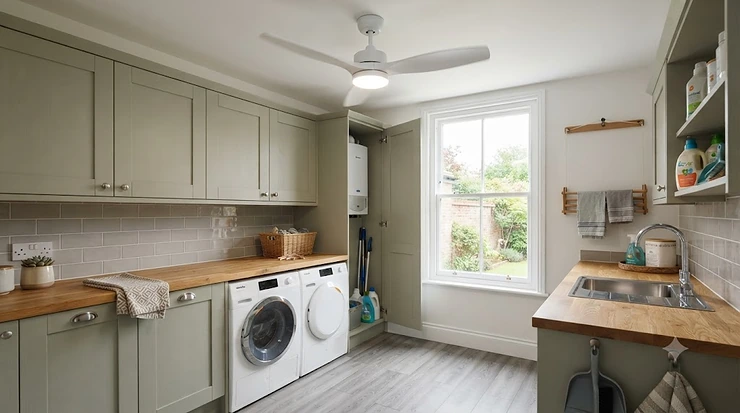
If you’ve ever opened the door to your utility room and been hit by that warm, laundry-scented fug of trapped air, you already know why utility room ceiling fans have quietly become one of the most searched fixes for British homes in 2026. It’s not a glamorous room. Nobody photographs their utility room for Pinterest. But it’s also the one space in the house doing the most unseen work — tumble dryer venting, washing machine steam, boiler heat, wellies drying by the door — all while getting the least ventilation attention of any room in the house.

A ceiling fan sounds almost too simple a fix for that. Bear with me, though, because the physics is sound: moving air stops moisture settling on cold surfaces long enough to become mould, and it does it silently, cheaply, and without you lifting a finger after installation day. This guide walks through seven real, currently available fans — from a £90-ish flush-mount option to a smart 52-inch model — with honest analysis of who each one suits, what the spec sheets actually mean in your utility room, and where the marketing claims need a pinch of salt. Affiliate disclosure: this article contains Amazon Associate links, and we may earn a small commission on qualifying purchases at no extra cost to you.
What Is a Utility Room Ceiling Fan?
A utility room ceiling fan is a compact, ceiling-mounted circulation fan — typically 30 to 52 inches in diameter — designed to keep air moving in small, often humid service spaces like laundry rooms, boot rooms, and plant rooms, reducing condensation build-up and speeding up the drying of damp air between uses of extractor ventilation.
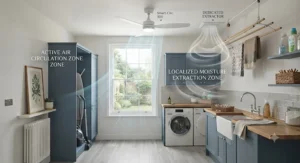
Unlike an extractor fan, which pulls moist air out through a duct to the outside, a ceiling fan simply circulates the air already in the room. That distinction matters more than most buying guides let on, and we’ll come back to it later, because it changes which fan is right for which utility room. Under Approved Document F of the Building Regulations, any new kitchen, bathroom or utility room in England is expected to have proper extract ventilation to reduce condensation, which is worth keeping in mind before treating a ceiling fan as your only fix.
Quick Comparison Table
| Fan | Size | Motor | Best For |
|---|---|---|---|
| Westinghouse Petite 30″ | 30″ (76cm) | AC hugger | Tiny box-room utility spaces |
| Fantasia Capri 36″ | 36″ (91cm) | AC | Compact laundry rooms with light |
| Fantasia Blade 42″ | 42″ (107cm) | AC | Budget no-frills workhorse |
| Newday 42″ Silver | 42″ (107cm) | DC | Quiet, whisper-low daily use |
| BOOSANT 52″ IP44 | 52″ (132cm) | DC | Damp, steamy laundry/boot rooms |
| DREO Smart 52″ | 52″ (132cm) | DC | Larger utility rooms, app control |
| Westinghouse Bendan 52″ | 52″ (132cm) | AC | Larger boot rooms, heritage look |
Even a glance at this table tells you something the product pages won’t: there’s a clear split between compact AC fans built for pokey box-room utility spaces and larger DC-driven models built for bigger laundry-and-boot-room combos. If your utility room is genuinely tiny — think 4 to 6 square metres, the size of a large cupboard — the 52-inch options will look and feel oversized, practically brushing the walls. Buyers consistently underestimate how much a fan’s blade diameter dominates a small ceiling, so measuring your room before falling for a big, dramatic model matters more here than almost anywhere else in the house.
💬 Just one click — help others make better buying decisions too!😊
Top 7 Utility Room Ceiling Fans: Expert Analysis
Coverage below spans budget, mid-range and premium picks, plus a dedicated damp-rated option for utility rooms that double as laundry or boot rooms. Every product name stays in bold throughout so you can scan and compare at a glance.
1. Westinghouse Petite 30″ — smallest hugger mount for tight ceilings
The standout here is the hugger (flush) mount, which sits almost flat against the ceiling rather than dropping on a rod — genuinely useful if your utility room has a lower-than-average ceiling height, as many do in converted garages and lean-to extensions. Key specs: a 30-inch span with six reversible blades (white or rosewood/light maple, depending on finish), an integrated 9.8-watt LED bulb behind opal mushroom glass, and a manufacturer sizing guide capping it at rooms up to roughly 9 square metres. In practice that means the airflow is modest rather than powerful — this fan is about gentle, constant circulation, not gale-force drying.
Based on the spec comparison with its larger siblings, the Westinghouse Petite 30″ is the pick for genuinely small utility rooms where a bigger blade sweep simply wouldn’t clear the walls or light fittings. Beginners renovating a box-room utility space, and anyone prioritising a neat, low-profile finish over raw air movement, should look here first. Westinghouse backs the motor with a lifetime warranty and two years on parts, which is a longer commitment than most budget brands offer and worth factoring into any value comparison. Independent review data wasn’t fully verifiable for this specific finish during research, so treat the warranty terms and Westinghouse’s long manufacturing track record as your main quality signal rather than star ratings alone.
Pros:
- ✅ Genuine hugger mount suits low ceilings
- ✅ Lifetime motor warranty, two years on parts
- ✅ LED light kit included, no separate bulb needed
Cons:
- ❌ Airflow modest — not built for larger rooms
- ❌ AC motor uses more power than DC rivals
Typically found in the budget bracket, around £80-£120 depending on finish, this represents solid value if your utility room genuinely is on the small side; check current price and colour availability before ordering, as brushed nickel and white variants are priced separately.
2. Fantasia Capri 36″ — compact British brand pick with light
The standout feature is size-to-light ratio: at 36 inches, the Fantasia Capri 36″ is small enough for a genuinely tight laundry room yet still carries an integrated light fitting, saving you a separate ceiling rose. Fantasia has been designing ceiling fans specifically for the UK market since 1985, based in Kent, which matters more than it sounds — British utility rooms tend to have lower ceilings and smaller floor areas than the American rooms most global fan brands are designed around, so a UK-native design brief often fits better out of the box.
What most buyers overlook about compact fans like this one is that smaller blades spin faster to move the same volume of air, which can mean a touch more motor noise on the top speed setting — something to weigh if your utility room backs onto a home office or bedroom wall. On the plus side, real Amazon customer Q&A for this exact model confirms it performs well in rooms of around 10 square metres, with one verified buyer specifically noting “no wobble at high speed” even at three metres from the light fitting — a genuinely useful data point given wobble is the most common complaint about cheap fans generally. Fantasia’s broader range carries a 10-year motor guarantee on its Elite line, a meaningfully longer commitment than most rivals in this price bracket.
Pros:
- ✅ Compact 36″ size fits small laundry rooms
- ✅ Integrated light saves a separate fitting
- ✅ Verified buyer reports confirm no high-speed wobble
Cons:
- ❌ Smaller blades mean more audible top-speed hum
- ❌ AC motor, not the most energy-efficient option
Price sits in the low-to-mid range, roughly £100-£150 at the time of research; as with all these fans, check current pricing on the listing since Fantasia periodically runs promotions on older colourways.
3. Fantasia Blade 42″ — budget no-frills workhorse
This one’s standout feature is honesty of purpose: no light kit, no app, no smart speaker integration, just a 42-inch white fan built to move air reliably and cheaply. The Fantasia Blade 42″ uses double-sealed bearing motors, a detail Fantasia applies across its range specifically to cut down the rattling hum that cheaper fans develop after a year or two of daily use — a sensible engineering choice given utility rooms often run their fan more hours per day than any other room, given the appliance load.
Here’s what to weigh: because there’s no light kit, you’ll need existing ceiling lighting in the room already, which most utility rooms have anyway since they were typically wired for a single pendant. What the spec sheet won’t tell you outright is that stripped-back AC fans like this tend to be the most repairable long-term, since there’s less integrated electronics to fail — no app, no LED driver board, just a motor and a pull-cord or wall switch. For anyone furnishing a utility room on a tight renovation budget, or replacing a fan that’s failed in a rental property, this is the pragmatic choice rather than the exciting one.
Pros:
- ✅ Simple, repairable design with no electronics to fail
- ✅ Double-sealed bearings reduce long-term rattle
- ✅ Lowest price point of the seven featured fans
Cons:
- ❌ No integrated light — needs existing fitting
- ❌ AC motor, no app or voice control options
Expect a price under £100 in most cases, making it the cheapest entry point here; value-wise it’s hard to beat if all you need is reliable air movement over a washing machine and dryer.
4. Newday 42″ Silver — quiet DC pick for daily use
The standout advantage is noise, or rather the lack of it — Newday markets this brushed nickel model with a DC motor rated below 35 decibels, which is roughly the ambient hum of a quiet refrigerator. Given utility rooms frequently sit adjacent to kitchens, hallways or even bedrooms in smaller UK homes, a fan that runs almost unnoticeably matters more here than in a detached garage conversion. Six speed settings, a remote control, dimmable LED lighting and a memory function that restores your last-used settings after a power cut round out the feature list.
Reviewers consistently note that DC motors like this one sip power compared with older AC designs — DC ceiling fans typically use 50 to 60 percent less electricity than AC equivalents for equivalent airflow, according to UK ceiling fan retailers. On paper this means a fan you can genuinely leave running most of the day without troubling your electricity bill, which suits the utility room’s habit of needing near-constant background circulation while the tumble dryer works through a cycle. The brushed nickel finish also reads as more contemporary than the classic white AC fans further down this list, worth noting if your utility room has been recently renovated with modern fittings.
Pros:
- ✅ Whisper-quiet DC motor, rated under 35dB
- ✅ Memory function restores settings after power cuts
- ✅ Dimmable LED light and full remote control
Cons:
- ❌ Mid-range price, not the cheapest option here
- ❌ 42″ may be too large for very small rooms
Sitting in the mid-£300s to low-£400s range on many listings — though Amazon pricing fluctuates, so always check current price before buying — this represents strong all-round value for a utility room that’s used daily and sits near living spaces.
5. BOOSANT 52″ IP44 — waterproof pick for damp laundry rooms
This is the fan built specifically for the problem utility rooms actually have: moisture. The standout feature is its IP44 ingress protection rating, meaning it’s certified against splashing water and fine dust ingress — a genuinely different specification tier from the other fans on this list, most of which are rated for dry indoor rooms only. If your utility room shares space with an unvented tumble dryer, or the washing machine has a habit of leaving the door open and letting steam roll out, this rating stops being a nice-to-have and becomes the deciding factor.
The 35-watt DC motor claims up to 230 rpm and roughly 7,230 CFM of airflow on its top setting, which is genuinely powerful for a domestic ceiling fan — more comparable to a small industrial circulator than a bedroom fan. Three colour temperatures (3000K, 4500K, 6000K) via the integrated LED let you match lighting to the room’s mood, from warm evening laundry-folding to bright daytime task lighting, and both app and remote control cover you whether your phone or the wall switch is more convenient mid-load. Independent long-term reliability reviews weren’t fully verifiable during this research pass, so weigh the ETL certification and IP44 rating — both third-party tested standards rather than marketing claims — as your main confidence signal here rather than star ratings alone.
Pros:
- ✅ IP44-rated for splash and moisture resistance
- ✅ Powerful 7,230 CFM airflow on top speed
- ✅ Three colour temperatures via app or remote
Cons:
- ❌ Large 52″ blade span needs a bigger room
- ❌ Premium price for the category
Typically priced in the £150-£220 range, the BOOSANT 52″ IP44 costs more than a standard indoor fan, but the waterproof rating genuinely changes what rooms it can safely go in — for a damp utility or boot room, that premium buys peace of mind an ordinary fan simply can’t offer.
6. DREO Smart 52″ — best for app control and larger spaces
The standout feature is refinement: a claimed 22-decibel noise floor, which DREO positions as near-silent, alongside 12 distinct speed settings rather than the usual three to six. That granularity actually matters in a utility room more than you’d expect — you want a gentle setting for background circulation while you’re folding washing nearby, and a much stronger setting for clearing steam quickly after running the dryer, and 12 steps lets you dial in exactly the right point rather than jumping between “too gentle” and “too loud.”
App and Alexa control mean you can schedule the fan to run automatically during typical laundry hours, or trigger it remotely the moment you start a dryer cycle from another room — a genuinely practical use case that most bedroom-focused smart fans don’t optimise for. The stepless colour-tone dimmable LED light and 12-hour timer round out a feature set clearly aimed at buyers who want their utility room to feel considered rather than purely functional. What most buyers overlook about smart ceiling fans generally is the dependency on a stable home Wi-Fi signal reaching the utility room, which — being often at the back of the house near a boiler or breeze-block wall — isn’t always guaranteed; test your signal strength there before committing to app-only control as your main method.
Pros:
- ✅ 12 speed settings for precise airflow control
- ✅ App and Alexa scheduling for laundry routines
- ✅ Claimed 22dB noise floor, among the quietest here
Cons:
- ❌ Smart features depend on reliable Wi-Fi coverage
- ❌ Largest, priciest option for smaller utility rooms
Expect a premium price point, generally upwards of £150-£250 depending on retailer promotions; it’s the most expensive fan on this list, and rightly positioned for utility rooms where control and quiet operation matter as much as raw airflow.
7. Westinghouse Bendan 52″ — heritage pick for larger boot rooms
The standout here is old-fashioned build confidence — Westinghouse has manufactured electrical products for over 140 years, and the Westinghouse Bendan 52″ leans into that heritage with a classic five-blade white finish and frosted opal glass light kit that wouldn’t look out of place in a period conversion or farmhouse-style boot room. The three-speed AC motor is a deliberate trade-off: less energy-efficient than the DC options above, but simpler mechanically and backed by decades of the same basic, well-proven design.
Reviewers consistently point to the warm, diffused light quality from the opal glass shade as a genuine step up from the harsher LED strips some rivals use, which suits utility rooms that double as boot rooms or transitional spaces where softer lighting is more welcome than clinical brightness. On paper this means you’re buying character and dependability over cutting-edge efficiency — a reasonable trade for anyone furnishing a larger utility-slash-boot-room in an older property where matching the existing aesthetic outweighs shaving pounds off the electricity bill.
Pros:
- ✅ Warm, diffused opal glass light kit
- ✅ Traditional styling suits period properties
- ✅ Backed by Westinghouse’s long manufacturing legacy
Cons:
- ❌ Three-speed AC motor less efficient than DC rivals
- ❌ Large 52″ size needs adequate ceiling clearance
At around £125.99-£169.99, this sits at the upper-mid price point of the group, and the styling premium is the honest reason why — you’re paying for finish and heritage rather than smart features.
Full Spec Comparison: All 7 Fans Side by Side
| Fan | Size | Motor Type | Light | Control | Best For |
|---|---|---|---|---|---|
| Westinghouse Petite 30″ | 30″ | AC | Integrated LED | Wall/pull | Tiny box rooms |
| Fantasia Capri 36″ | 36″ | AC | Integrated | Wall/pull | Compact laundry rooms |
| Fantasia Blade 42″ | 42″ | AC | None | Pull cord | Budget replacements |
| Newday 42″ Silver | 42″ | DC | Dimmable LED | Remote | Quiet daily use |
| BOOSANT 52″ IP44 | 52″ | DC | 3-CCT LED | App/remote | Damp laundry rooms |
| DREO Smart 52″ | 52″ | DC | Dimmable LED | App/Alexa | Larger, tech-forward rooms |
| Westinghouse Bendan 52″ | 52″ | AC | Opal glass | Remote | Period boot rooms |
Laid out this way, the pattern is obvious: every DC-motor fan on this list also happens to be the quieter, more efficient option, while every AC fan trades some running cost for either a lower purchase price or a more traditional look. If long-term running cost matters more to you than upfront spend — which it usually should for a fan you’ll run most days — the DC options represent the stronger long-term value despite the higher sticker price.
Practical Usage Guide: Installing and Maintaining Practical Utility Fans
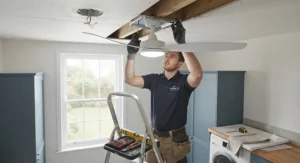
Getting a new ceiling fan right on day one saves you a return trip up the ladder six months later. First, confirm your existing ceiling rose or fan bracket can bear the weight — most utility room joists handle a standard fan without reinforcement, but Victorian and older properties with lath-and-plaster ceilings sometimes need a dedicated fan-rated mounting box, which any qualified electrician can fit in under an hour. Second, mind the clearance: UK wiring regulations generally expect at least 2.3 metres from floor to blade tip in a room people walk through regularly, so measure before ordering a 52-inch model for a room with a standard 2.4-metre ceiling.
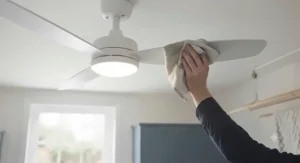
Once fitted, the maintenance routine for practical utility fans is refreshingly low: wipe blades monthly with a dry microfibre cloth to stop dust building into visible clumps (dust is what causes most fan wobble over time, not manufacturing defects), and check screws and mounting brackets are still tight every six months, since the vibration from nearby washing machines can gradually loosen fixings that a bedroom fan would never experience. A common first-30-days mistake is running the fan on its highest setting constantly out of enthusiasm — most manufacturers recommend a mid-range daily setting, reserving the top speed for clearing steam quickly after a dryer cycle rather than as the default.
Real-World Scenarios: Matching Functional Room Ceiling Fans to Your Space
Consider three fairly typical UK households. First, a young couple in a two-bed terrace with a galley-style utility cupboard off the kitchen, roughly 3 square metres, running the washing machine most days and drying clothes on an airer through winter. For them, the Westinghouse Petite 30″ or Fantasia Capri 36″ makes sense — small enough to suit the space, cheap enough to justify for a room that size, and adequate for gentle daily circulation.
Second, a family of four in a converted garage utility-boot room, around 8 square metres, where wellies, coats and a chest freezer share space with the washer-dryer, and steam is a regular occurrence after school-run mornings. Here the damp-resistant BOOSANT 52″ IP44 earns its premium price, since the room genuinely experiences the splash and humidity conditions its rating is designed for. Third, a professional couple who’ve fitted smart heating and lighting throughout a newer-build home and want their utility room to match — for them, the DREO Smart 52″ is the natural fit, letting them schedule circulation around their laundry routine from an app rather than remembering a wall switch.
Problem → Solution: Fixing Common Utility Space Ventilation Issues
Musty smells that linger after washing: the usual cause is stagnant air sitting undisturbed between wash loads, and the fix is running your fan on a low, near-constant setting rather than only switching it on when you notice the smell — prevention beats cure here. Condensation on the utility room window or external door: this points to warm, moist air meeting a cold surface, and while a ceiling fan helps by keeping air moving so it doesn’t settle, pairing it with an extractor fan vented outside solves the root cause rather than just the symptom.
Visible mould spotting in room corners: condensation is the most common underlying cause of damp, usually recognisable as small black dots near cold surfaces like window frames, so a ceiling fan alone won’t reverse existing mould — you’ll need to treat the affected area and improve ventilation together, and the NHS guidance on damp and mould is a genuinely useful starting point for households dealing with this. Fan noise disturbing an adjacent room: switch to a DC model like the Newday 42″ Silver or DREO Smart 52″, since AC motors are almost always the noisier culprit on higher speed settings.
How to Choose Utility Room Ceiling Fans: 7 Steps
- Measure your room first. A 52-inch fan in a 4-square-metre utility cupboard will dominate the ceiling and may not have safe wall clearance — match blade span to floor area before anything else.
- Check the ceiling height. Anything under 2.4 metres generally calls for a hugger or flush-mount design like the Westinghouse Petite 30″ rather than a rod-mounted fan.
- Decide if you need moisture protection. If steam or splashing is a regular occurrence, prioritise a fan with a proper IP rating — such as the BOOSANT 52″ IP44 — over a standard indoor fan.
- Weigh AC against DC. DC motors cost more upfront but run quieter and cheaper day to day — worth it for a fan used most days of the week.
- Confirm existing lighting. Fans without an integrated light kit, like the Fantasia Blade 42″, only make sense if the room already has a working light fitting.
- Think about control method. Pull cords suit rooms you walk past occasionally; remote or app control suits rooms you want to adjust without going in, useful mid-laundry-cycle.
- Set a realistic budget band. Expect roughly £80-£150 for budget AC fans and £150-£250 for premium DC or IP-rated models — check current prices, as promotions shift these ranges regularly.
Common Mistakes When Buying Functional Room Ceiling Fans
The single most common mistake is treating a ceiling fan as a replacement for extractor ventilation rather than a complement to it — a fan circulates air that’s already in the room, it doesn’t remove moisture from the building the way a ducted extractor does. Buyers also frequently oversize for the room, drawn to a dramatic 52-inch fan that photographs well but leaves barely 30cm of wall clearance in a genuinely small utility space, which both looks wrong and can breach minimum safety clearances.
A third mistake is ignoring IP ratings entirely for rooms that clearly get damp — a standard indoor-rated fan running in a steamy laundry room isn’t just a wasted purchase, it’s a genuine electrical safety consideration over the fan’s lifespan. Finally, buyers underestimate installation costs: while the fan itself might sit in the £100-£200 range, a qualified electrician’s time to fit a new ceiling rose or upgrade wiring can add a meaningful amount on top, so it’s worth getting a rough installation quote before you commit to a specific model.
Utility Room Ceiling Fans vs Extractor Fans
These two solve genuinely different problems, and confusing them is the single biggest source of buyer’s remorse in this category. A ceiling fan circulates air within the room — it cools you through moving air across your skin and stops moisture settling on cold surfaces by keeping the air stirred, but it does not remove that moisture from the building. An extractor fan, typically wall or window mounted with ducting to the outside, physically pulls humid air out and replaces it with drier air from elsewhere in the house.
| Feature | Ceiling Fan | Extractor Fan |
|---|---|---|
| Moves air within room | Yes | No |
| Removes moisture from building | No | Yes |
| Typical noise level | Low-moderate | Moderate-high |
| Building regs relevance | Minimal | Governed by Approved Document F |
| Best for | Daily comfort, gentle drying | Post-shower/wash steam removal |
As UK Building Regulations guidance sets out, extract ventilation is specifically required in rooms of increased humidity to reduce condensation and remove smells — a role a ceiling fan genuinely cannot fulfil on its own, however powerful. The most effective utility rooms in practice run both: an extractor fan for the acute steam load during and immediately after a wash or dry cycle, and a ceiling fan for gentle, ongoing circulation the rest of the time.
What to Expect: Real-World Performance for Service Room Cooling
On paper, a 52-inch fan moving 7,000-plus CFM sounds dramatic, but in a genuinely small utility room that airflow figure is somewhat academic — you’ll rarely run it at full tilt for more than a few minutes after a hot dryer cycle. Day-to-day, what you’ll actually notice is a gentle, barely-there breeze that keeps the room from feeling stuffy, plus a modest but real drop in how quickly condensation forms on a cold window in winter. Service room cooling in a utility context isn’t about dramatic temperature drops the way it might be in a living room on a hot July afternoon; it’s about preventing the specific, slow build-up of stagnant, moisture-laden air that makes a small enclosed room start to smell.
Expect the DC-motor fans to feel noticeably calmer in daily use than the AC options — not just quieter in decibel terms, but smoother in how the speed ramps up and down, since DC motors typically offer finer-grained speed control. If your priority is drying washing hung on an indoor airer faster, position matters more than fan power: a fan mounted directly above the airer, even on a low-mid setting, will outperform a more powerful fan mounted off to one side.
Functional Area Airflow for Different Utility Rooms
Not every utility room is the same shape of problem. A galley utility room tucked beside a kitchen typically needs the smallest, quietest fan on this list — the Westinghouse Petite 30″ or Fantasia Capri 36″ — since the priority is subtlety over power. A converted garage utility-slash-boot room, often larger and colder with an exterior door opening regularly, benefits from a bigger, more powerful fan like the BOOSANT 52″ IP44 or Westinghouse Bendan 52″, both suited to the larger air volume and, in the BOOSANT’s case, the greater moisture exposure from wet coats and boots.
A plant room utility space housing a boiler alongside the washing machine has an added consideration: heat. These fans aren’t designed to withstand sustained high temperatures near a boiler flue, so keep at least a metre of clearance from any heat source regardless of which model you choose, and consult a qualified installer if you’re unsure about proximity to gas appliances.
Long-Term Cost & Maintenance
Running cost is where DC and AC motors genuinely diverge over a fan’s lifetime. A typical AC ceiling fan draws somewhere in the region of 60-75 watts on its highest setting, while an equivalent DC fan like the Newday 42″ Silver or DREO Smart 52″ often draws under 35 watts for comparable airflow — roughly half. Run either fan for, say, four hours a day, and over a year that difference adds up to a modest but real saving on your electricity bill, typically a handful of pounds rather than a dramatic sum, but it compounds over a fan’s typical 10-plus-year lifespan.
Maintenance costs are low across the board provided you keep blades dust-free and fixings tight, as covered earlier. The main long-term cost risk is buying an indoor-only fan for a genuinely damp utility room — corrosion or motor failure from unmanaged moisture exposure is the most common reason a ceiling fan fails early, and it’s not typically covered under standard warranty terms, since it stems from installing the wrong-rated product for the environment rather than a manufacturing fault.
Safety, IP Ratings & Building Regulations Guide
IP ratings look like a marketing gimmick until you understand what they actually certify: a genuine, independently tested classification of how well a device resists water and dust, not a brand’s own claim. For utility rooms specifically, an IP44 rating (as fitted to the BOOSANT 52″ IP44) means protection against solid objects over 1mm and splashing water from any direction, which broadly matches the exposure a laundry or boot room actually experiences.
For a deeper practical breakdown of what different IP ratings mean room by room, Screwfix’s guide to electrical bathroom zones is a genuinely useful reference, even though it’s written for bathrooms — the same principles of matching IP rating to moisture exposure apply directly to a damp utility room. As a general safety rule, always have ceiling fan installation and any new wiring carried out or signed off by a qualified electrician, particularly in rooms with existing damp or older wiring, and never install a standard indoor-rated fan in a room that regularly experiences direct splashing or steam.
Features That Actually Matter (And Those That Don’t)
Genuinely worth paying for: a DC motor if you’ll run the fan daily, an appropriate IP rating if your utility room gets properly damp, and a reversible motor direction, which lets you push warm air down in winter rather than just cooling in summer — most fans here include this, but it’s worth double-checking before purchase. Genuinely skippable for most utility rooms: Alexa integration, unless you specifically want scheduled automation; multiple colour temperatures beyond warm and cool white, since utility rooms rarely need mood lighting; and remote controls with dozens of preset modes, most of which go unused once the novelty wears off.
The spec that gets the most marketing attention but matters least in a utility room specifically is CFM (cubic feet per minute) airflow rating — impressive on paper, but in a room this size you’ll almost never run a fan at the setting needed to hit peak CFM, making it more of a bragging-rights number than a practical buying criterion.
FAQ
❓ Do I need a ceiling fan or an extractor fan in a utility room?
❓ Can a ceiling fan go in a damp utility room?
❓ What size ceiling fan suits a small utility room?
❓ Are DC ceiling fans worth the extra cost over AC?
❓ Do utility room ceiling fans help with mould?
Conclusion
Utility room ceiling fans aren’t a glamorous purchase, but they’re a genuinely sensible one — cheap to run, simple to install, and quietly effective at stopping the specific, slow build-up of stale, moisture-laden air that makes a small service room start to smell musty. The right choice really does come down to your room: go small and simple with the Westinghouse Petite 30″ or Fantasia Capri 36″ for a tight laundry cupboard, reach for the damp-rated BOOSANT 52″ IP44 if steam and splashing are a regular reality, or pick the DREO Smart 52″ if you want app-scheduled control over a larger space.
None of these fans replace proper extract ventilation where building regulations require it, and none of them will fix existing damp on their own — but paired sensibly with the right ventilation strategy for your home, any one of these seven genuinely solves the everyday problem of a stuffy, humid utility room. Measure your space, be honest about how damp it actually gets, and pick accordingly.
✨ Don’t Miss These Exclusive Deals!
🔍 Take your utility room from stuffy to sorted with any of the picks above — click through to check current pricing and availability before they change, and give your laundry days a little more breathing room!
Recommended for You
- Hugger Ceiling Fans 2026: 7 Best Low-Profile Loft Picks
- Ceiling Fan for 45 Degree Slope: 7 Genuine Fixes for 2026
- Ceiling Fan For Sloped Ceiling: 7 Angled Picks for 2026
Disclaimer: This article contains affiliate links. As an Amazon Associate, I earn from qualifying purchases. If you purchase products through these links, we may earn a small commission at no additional cost to you.
✨ Found this helpful? Share it with your friends! 💬🤗
